





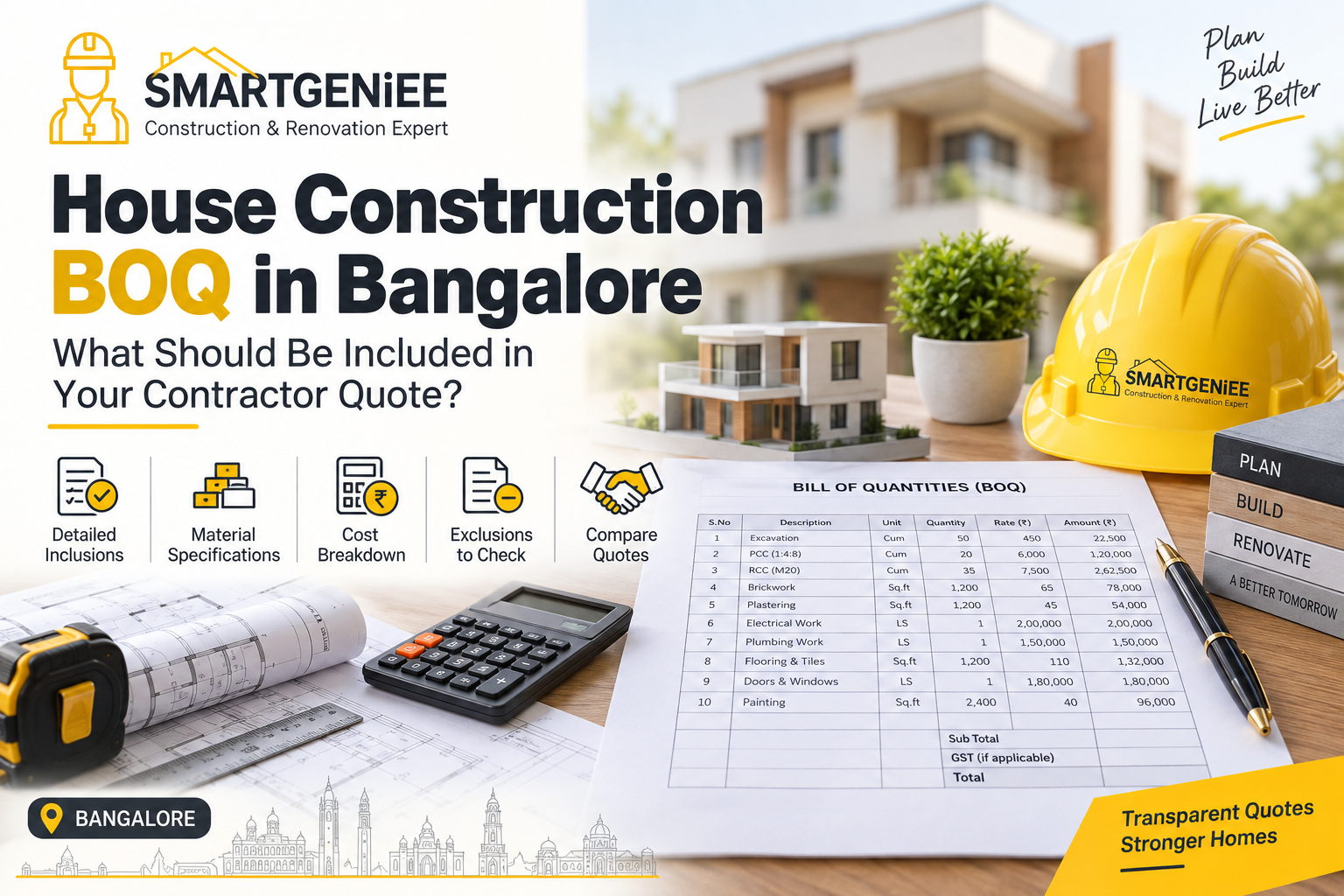

House Construction BOQ in Bangalore: What Should Be Included in Your Contractor Quote?
When you start planning a house in Bangalore, one of the first things you will probably receive from a construction company is a quotation.
But a quotation showing only:
₹2,500 per sq. ft.
doesn’t tell you enough.
What materials are included?
What grade of steel will be used?
Which tiles are covered?
Are electrical fittings included?
What about waterproofing?
Are doors and windows included?
Is the compound wall part of the quote?
What happens if you change something during construction?
This is where a Bill of Quantities (BOQ) becomes important.
A BOQ provides a structured way to understand the scope, quantities, specifications, materials and costs associated with a construction project.
For homeowners in Bangalore, understanding the BOQ before signing a construction contract can make it much easier to compare contractors, identify exclusions and avoid unexpected costs later.
In this guide, we explain what a house construction BOQ should include, how to compare BOQs and what homeowners should check before accepting a construction quotation.
What Is a BOQ in House Construction?
BOQ stands for Bill of Quantities.
In residential construction, a BOQ is a detailed document that describes the work and materials required for a project, along with relevant quantities, specifications and pricing where applicable.
Instead of looking only at the final construction cost, a BOQ helps break the project into individual components.
For example:
Foundation → RCC → Masonry → Plastering → Electrical → Plumbing → Flooring → Doors & Windows → Painting → Finishing
The exact format can vary between construction companies and projects.
The purpose is to make the scope easier for the homeowner and contractor to understand before execution begins.
Why Is a BOQ Important for Your Bangalore Home?
A house is made up of hundreds of individual construction and finishing decisions.
Without a detailed scope, two contractors can quote very different prices for what appears to be the same house.
For example:
Contractor A: ₹2,200/sq. ft.
Contractor B: ₹2,500/sq. ft.
At first glance, Contractor A appears cheaper.
But suppose Contractor A has:
- Lower tile allowance
- Basic sanitaryware
- Fewer electrical points
- Different window specifications
- No waterproofing in certain areas
- Excluded compound wall
- No kitchen
- Limited painting scope
while Contractor B includes these items.
The ₹300 difference may therefore not represent a genuine price difference.
This is why homeowners should compare scope and specifications, not just the per-square-foot rate.
What Should a House Construction BOQ Include?
A good residential BOQ should provide clarity across the major construction stages.
Here are the key sections you should look for.
1. Project Information
The BOQ should begin with basic project details.
This may include:
- Homeowner name
- Project location
- Plot dimensions
- Proposed built-up area
- Number of floors
- Project type
- Drawing/reference numbers
- Date of quotation
- BOQ revision number
For example:
Project: Residential House
Location: Bangalore
Plot: 30×40
Configuration: G+1
Built-up Area: As per approved architectural drawings
This prevents confusion about which project the quotation applies to.
2. Site Preparation and Excavation
The BOQ should clarify the scope of initial site work.
Depending on the project, this can include:
- Site clearing
- Excavation
- Earthwork
- Soil disposal
- Filling
- Levelling
- PCC
- Foundation-related preparation
If excavation encounters unexpected site conditions, the contract should explain how additional work will be handled.
3. Foundation Work
The foundation section should identify the major components of the structural work.
It may include:
- Footings
- Reinforcement
- PCC
- Foundation concrete
- Foundation masonry where applicable
- Plinth beam
- Backfilling
- Anti-termite treatment where specified
The structural design should determine the actual foundation requirements.
Important: A BOQ should not be used as a substitute for structural engineering. Foundation dimensions and reinforcement should follow the structural design prepared for the project.
4. RCC Structure
The RCC section is one of the most important parts of a residential construction BOQ.
It may cover:
- Columns
- Beams
- Slabs
- Staircase
- Reinforcement steel
- Concrete
- Shuttering/formwork
- Related structural work
Ask for clarity on:
Steel
- Grade
- Manufacturer/brand requirements where specified
- Reinforcement specifications
- Measurement basis
Concrete
- Concrete grade
- Whether ready-mix or site-mixed concrete is proposed
- Scope of supply and labour
Formwork
- Formwork/shuttering scope
- Staircase formwork
- Slab formwork
- Beam and column formwork
You don’t need to become a structural engineer to review a BOQ, but you should make sure the contractor’s scope aligns with the structural drawings.
5. Brickwork or Blockwork
The BOQ should specify the walling material.
For example:
- Red brick
- Concrete blocks
- AAC blocks
- Other approved masonry systems
It should also clarify:
- Wall thickness
- Internal/external wall application
- Mortar requirements
- Labour
- Openings
- Lintels where applicable
Avoid accepting a quotation that simply says:
Brickwork – Included
without further specification.
6. Plastering
Plastering should also be clearly defined.
The BOQ can specify:
- Internal plaster
- External plaster
- Ceiling plaster where applicable
- Surface preparation
- Thickness/specification
- Labour
External plastering and internal plastering may have different requirements, so they should not simply be grouped under one vague line item.
7. Waterproofing
Waterproofing deserves special attention.
The BOQ should identify where waterproofing is included.
Common areas include:
- Bathrooms
- Balconies
- Terraces
- Utility areas
- Wet areas
- Sunken portions where applicable
Ask:
What waterproofing system is being used?
Also clarify:
- Application method
- Number of coats/layers where relevant
- Testing procedure
- Areas covered
- Warranty/defect responsibility, if offered
A low quotation that excludes important waterproofing work can become expensive later.
8. Electrical Work
A proper BOQ should not simply say:
Electrical – Included
It should provide enough information to understand the scope.
Check for:
- Electrical conduits
- Wiring
- Switch boxes
- Distribution board
- Switches
- Sockets
- Lighting points
- Fan points
- AC points
- Geyser points
- TV points
- Internet/data points
- CCTV provisions
- Doorbell
- Outdoor electrical points
The number of electrical points can significantly affect the overall cost.
Therefore, the electrical layout should ideally be finalised before the quotation is locked.
9. Plumbing Work
The plumbing section should specify:
- Water supply pipes
- Drainage pipes
- Bathroom plumbing
- Kitchen plumbing
- Utility plumbing
- Tank connections
- External plumbing where included
- Sanitaryware installation
You should also check the pipe material and specification.
10. Bathroom and Sanitaryware
Don’t accept a quote that simply says:
Bathroom fittings – ₹X
without knowing what that allowance covers.
Check:
- WC
- Wash basin
- Faucets
- Shower
- Health faucet
- Floor drain
- Accessories
- Mirror, if included
- Installation
Brand and model allowances can be particularly important here.
If a quotation specifies only a broad budget allowance, understand what happens if you select products above that allowance.
11. Flooring and Wall Tiles
The BOQ should specify the approximate material allowance and application.
Check:
- Living room flooring
- Bedroom flooring
- Kitchen flooring
- Bathroom tiles
- Wall tiles
- Balcony flooring
- Staircase finish
- Skirting
Also check whether the quote specifies:
- Tile price range
- Tile size
- Installation
- Adhesive
- Grouting
- Wastage
- Transportation
This becomes particularly important when you select premium or large-format tiles.
12. Doors and Windows
The doors and windows section should be detailed.
Check:
Main door
- Material
- Frame
- Shutter
- Hardware
- Finish
Internal doors
- Frame material
- Shutter material
- Hardware
- Finish
Windows
- Frame material
- Glass specification
- Mesh
- Hardware
- Installation
For example, a quotation saying “Windows included” isn’t sufficient.
A homeowner should know what type of windows are actually being provided.
13. Painting
Painting should specify the complete system rather than just saying:
Painting – Included
Check whether the scope includes:
- Surface preparation
- Putty
- Primer
- Interior paint
- Exterior paint
- Number of coats as applicable
- Touch-ups
Also clarify whether the quoted paint specification applies to all areas or whether some areas have separate allowances.
14. Staircase and Railing
For a G+1 or G+2 home, check whether the BOQ covers:
- Staircase construction
- Staircase finish
- Handrail
- Railing
- Glass/metal/other material
- Installation
A staircase can involve both structural and finishing costs, so it should not be overlooked.
15. Kitchen and Carpentry
This is an area where quotations can vary significantly.
Ask whether the following are included:
- Modular kitchen
- Kitchen cabinets
- Countertop
- Sink
- Hardware
- Wardrobes
- Loft storage
- TV unit
- Other fixed carpentry
If these aren’t included, make sure they are clearly listed under exclusions.
16. External Works
External works are often forgotten when homeowners compare construction rates.
Depending on the project, check whether the BOQ includes:
- Compound wall
- Main gate
- External flooring/paving
- Drainage
- Sump
- Water tank
- Borewell
- Landscaping
- Parking area
- External electrical points
These may be separate from the main building construction.
17. Labour and Supervision
The BOQ or construction agreement should make it clear how labour and project supervision are handled.
Ask:
- Is labour included in the quoted rate?
- Who manages subcontractors?
- Who supervises the site?
- Is a site engineer/project manager assigned?
- How frequently is quality inspected?
- Who coordinates material deliveries?
A construction project involves multiple teams, so project coordination is an important part of execution.
18. Material Brands and Specifications
One of the biggest weaknesses in many construction quotations is vague material descriptions.
Instead of:
Cement – Good quality
you should have a clearly defined specification or approved brand/category wherever appropriate.
The same applies to:
- Steel
- Cement
- Blocks/bricks
- Electrical wires
- Switches
- Plumbing pipes
- Tiles
- Sanitaryware
- Paint
- Waterproofing products
- Doors
- Windows
The BOQ should make it clear what standard is being offered.
BOQ Exclusions: The Section You Should Never Ignore
A good BOQ should not only tell you what is included.
It should also clearly state what is not included.
Common exclusions may include:
- Land cost
- Registration
- Certain approval/statutory charges
- Utility connection charges
- Borewell
- Sump
- Compound wall
- Gate
- Landscaping
- Modular kitchen
- Wardrobes
- Loose furniture
- Appliances
- Solar system
- Home automation
- Premium elevation
- Certain external works
The exact exclusions vary by contractor and project.
Never assume that something is included just because it is necessary for a complete house.
Ask for written clarification.
BOQ vs Construction Quotation: What Is the Difference?
These terms are often used interchangeably, but they serve different purposes.
Construction quotation
Usually communicates:
How much will this project cost?
BOQ
Provides greater detail about:
What work and materials are included in that cost?
A quotation can therefore contain or refer to a detailed BOQ.
For a homeowner, the combination is much more useful than a single headline rate.
Why ₹/Sq. Ft. Alone Is Not Enough
Suppose three contractors quote:
| Contractor | Rate |
|---|---|
| A | ₹2,100/sq. ft. |
| B | ₹2,400/sq. ft. |
| C | ₹2,700/sq. ft. |
It would be tempting to select Contractor A.
But before doing that, compare:
- Structural specifications
- Steel
- Cement
- Electrical
- Plumbing
- Tiles
- Sanitaryware
- Doors
- Windows
- Painting
- Waterproofing
- Kitchen
- Carpentry
- External works
- Project supervision
The cheapest rate isn’t necessarily the lowest total project cost.
How to Compare Two House Construction BOQs
Use a simple comparison sheet.
| Category | Contractor A | Contractor B |
|---|---|---|
| Built-up area | ||
| RCC specification | ||
| Steel specification | ||
| Cement specification | ||
| Walling material | ||
| Plastering | ||
| Waterproofing | ||
| Electrical | ||
| Plumbing | ||
| Flooring | ||
| Bathroom fittings | ||
| Doors | ||
| Windows | ||
| Painting | ||
| Kitchen | ||
| Wardrobes | ||
| Compound wall | ||
| External works | ||
| Supervision | ||
| Exclusions | ||
| Payment milestones | ||
| Warranty/defect terms |
Once both quotations are placed side by side, price differences become much easier to understand.
What Is a Variation in House Construction?
During construction, homeowners sometimes decide to change something.
For example:
- Upgrade tiles
- Add electrical points
- Change sanitaryware
- Modify a door
- Add a false ceiling
- Change the elevation
- Add a balcony feature
- Increase carpentry
These changes can affect the final cost.
A good construction agreement should explain how such variations or changes are handled.
Before approving a change, ask for:
Change requested → Additional/reduced quantity → Cost impact → Approval → Execution
This helps prevent surprises at the end of the project.
Payment Milestones Should Match Construction Progress
Your construction payment schedule should ideally be connected to clearly defined project milestones.
For example:
Foundation completion → Structural milestones → Masonry → MEP → Finishing → Handover
The exact payment structure depends on the contract.
Avoid agreeing to a payment schedule that is unclear about:
- What milestone triggers payment
- What work must be completed
- How variations are billed
- How additional work is approved
A written agreement is important.
10 Questions to Ask Before Accepting a Construction BOQ
Before signing, ask your contractor:
- What is the exact built-up area being quoted?
- What materials and specifications are included?
- Which brands or material standards are specified?
- What electrical points are included?
- What plumbing and sanitaryware are included?
- What waterproofing areas are covered?
- Are doors and windows included? What specifications?
- What external works are excluded?
- How are design changes and variations charged?
- Are payment milestones linked to completed work?
If the answers aren’t clear, the BOQ needs more clarification before you proceed.
Common BOQ Mistakes Homeowners Should Avoid
Mistake 1: Choosing the lowest ₹/sq. ft. rate
A lower rate may have a narrower scope.
Mistake 2: Not checking exclusions
Major expenses can sit outside the headline construction price.
Mistake 3: Accepting vague material descriptions
“Premium quality” isn’t a useful technical specification by itself.
Mistake 4: Not checking electrical points
Additional points later can increase cost.
Mistake 5: Ignoring waterproofing
Clarify the areas, method and responsibility.
Mistake 6: Not documenting changes
Verbal changes can lead to disagreements.
Mistake 7: Comparing different built-up areas
Make sure all contractors are quoting on the same area.
Mistake 8: Not checking finishing allowances
Tiles, sanitaryware, doors and windows can create significant price differences.
BOQ Checklist for Your Bangalore Home
Before finalising your contractor, make sure your BOQ covers:
Project
- Plot details
- Built-up area
- Number of floors
- Drawings
Structure
- Foundation
- RCC
- Steel
- Concrete
- Masonry
- Plastering
Services
- Electrical
- Plumbing
- Drainage
- Waterproofing
Finishing
- Flooring
- Tiles
- Doors
- Windows
- Painting
- Sanitaryware
- Railings
Other
- Kitchen
- Carpentry
- Compound wall
- Gate
- External works
- Supervision
Commercial
- Total cost
- Taxes, if applicable
- Payment milestones
- Exclusions
- Variation procedure
- Completion expectations
- Warranty/defect-liability terms
How Smartgeniee Approaches House Construction BOQs
At Smartgeniee Constructions & Renovation, we believe homeowners should understand the scope of their construction project before construction begins.
A construction estimate should not leave the homeowner guessing about what is included.
The project should be discussed in terms of:
Design → Scope → Specifications → BOQ → Construction → Quality Checks → Finishing → Handover
The exact materials, quantities and specifications should be determined based on the individual project’s architectural and structural requirements.
For a Bangalore homeowner, the objective should be to arrive at a construction scope that is clear, practical and measurable, rather than relying only on a headline per-square-foot figure.
If you’re planning to construct or renovate a home in Bangalore, Smartgeniee Constructions & Renovation can help you understand the scope of your project and plan the construction process around your requirements.
Frequently Asked Questions
What is a BOQ in house construction?
BOQ stands for Bill of Quantities. It is a structured document that details the work, materials, quantities and specifications involved in a construction project. It helps homeowners understand the scope behind a construction quotation.
Is a BOQ necessary for house construction?
A detailed BOQ is highly useful when comparing construction quotations because it helps identify differences in materials, specifications, inclusions and exclusions. It also provides greater clarity before construction begins.
What should a house construction BOQ include?
A residential BOQ should generally cover structural work, masonry, plastering, electrical, plumbing, waterproofing, flooring, doors, windows, painting, finishing and other agreed project components. It should also clearly identify exclusions and commercial terms.
Is the BOQ the same as a construction quotation?
Not exactly. A quotation primarily communicates the cost, while a BOQ provides greater detail about the scope, quantities and specifications behind that cost. A construction quotation may include or be accompanied by a BOQ.
Can I compare two contractors using their BOQs?
Yes. Comparing BOQs is one of the better ways to understand why two contractors may quote different prices. Compare the built-up area, materials, specifications, finishes, inclusions and exclusions before comparing the final price.
Does a BOQ include material brands?
It can. A detailed BOQ may specify brands, grades, product categories or acceptable alternatives depending on the project and agreement. Homeowners should clarify material specifications before signing.
Does the BOQ include labour?
Labour may be included depending on the construction contract and pricing model. Always confirm whether labour, supervision and subcontractor costs are included.
What happens if I change materials after signing the BOQ?
Changing materials or specifications can affect the project cost. The contractor should ideally provide the cost difference before the change is approved and executed.
Does a BOQ include interiors?
Not necessarily. Modular kitchens, wardrobes, false ceilings, furniture and other interior works may be included or excluded depending on the agreed scope. Check the BOQ carefully.
How do I get a BOQ for my house in Bangalore?
A project-specific BOQ should ideally be prepared after understanding the architectural drawings, structural requirements, built-up area, specifications and scope of work. A generic BOQ found online cannot accurately represent every house.
Final Takeaway
A ₹/sq. ft. construction rate is only the starting point when planning your home.
The more important question is:
“What exactly am I getting for that rate?”
A well-defined BOQ helps answer that question.
Before choosing a construction company in Bangalore, compare:
Built-up area + Structure + Materials + Electrical + Plumbing + Finishes + External works + Exclusions + Payment terms
Don’t select a contractor simply because the quoted rate looks low.
Compare the scope first. Then compare the price.
If you’re planning a house in Bangalore, Smartgeniee Constructions & Renovation can help you understand your construction requirements and plan the project with greater clarity from the beginning.


